
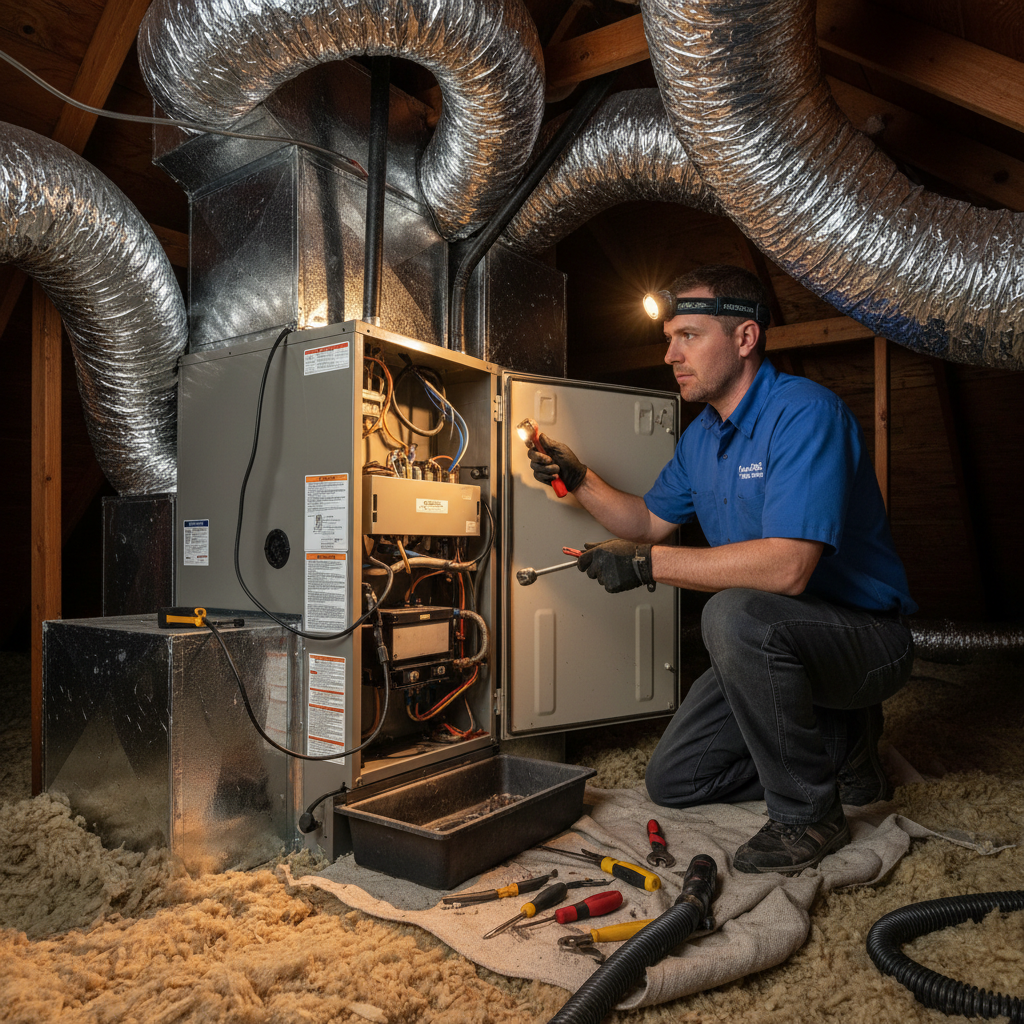
A generic HVAC maintenance checklist works fine in a mild climate. North Texas is not a mild climate. DFW homes need a maintenance plan designed for 100-degree summers, heavy humidity, long cooling seasons, and the wear those conditions put on equipment.
This guide explains why North Texas HVAC maintenance needs a region-specific approach — and what a DFW maintenance plan should actually cover.
Why North Texas HVAC Needs Specialized Maintenance
Three facts about DFW's climate change the maintenance math:
- Longer cooling season — DFW ACs run from late April through October, often 2,500+ hours per year
- Higher operating temperatures — cooling a home to 78°F when it's 102°F outside is near the design limit, stressing every component
- Heavy humidity load — Gulf moisture means ACs dehumidify constantly, which loads the coil and the condensate system
The same maintenance plan that keeps a Denver system healthy for 15 years might let a DFW system fail in 8. North Texas homeowners need more frequent checks, more aggressive cleaning, and earlier intervention.
What a DFW-Specific Maintenance Plan Should Cover
Spring Cooling Tune-Up (March–April)
Before the cooling season starts, a DFW tune-up should include:
- Condenser coil cleaning — DFW dust and cottonwood debris clog coils fast; a chemical clean restores heat rejection
- Evaporator coil inspection — check for the early corrosion that leads to refrigerant leaks
- Refrigerant charge verification — low charge is a leak warning; don't wait for warm air to find out
- Capacitor and contactor testing — DFW heat degrades these faster than anywhere; catch them before they fail
- Condensate drain clearing — DFW humidity means heavy water flow; a clog shuts the system down
- Electrical connection inspection — heat expands and contracts wiring, loosening connections over time
- Thermostat calibration — verify accurate temperature control before cooling season
- Filter replacement — start the season clean; see our air filter guide
See our complete spring preparation checklist for the full routine.
Fall Heating Tune-Up (October–November)
DFW winters are mild but real. A fall tune-up should include:
- Heat exchanger inspection — cracks in a heat exchanger can leak carbon monoxide
- Burner and flame sensor cleaning — dirty burners cause inefficient combustion and cycling issues
- Gas pressure verification — ensures safe, efficient heating
- Safety control testing — confirms the system shuts down properly on failure
- Filter replacement — a clean filter keeps the heating cycle efficient
- Thermostat switching — verify HEAT mode works before the first cold night
See our general preventive maintenance guide for the full case for bi-annual tune-ups.
Year-Round DFW Maintenance Habits
Between tune-ups, North Texas homeowners should:
- Check the air filter monthly — DFW dust clogs filters faster than the national average
- Keep the outdoor condenser clear — 2 feet of clearance on all sides, free of leaves and debris
- Watch for warning signs — longer cycles, warm air, ice, rising bills. See our AC repair guide
- Monitor indoor humidity — target 40–50%; above 60% means the system needs attention
What a DFW Maintenance Plan Costs — and Saves
A North Texas maintenance plan typically costs $150–$350 per year and includes:
- Two comprehensive tune-ups (spring cooling + fall heating)
- Priority same-day dispatch — critical during DFW's peak weeks
- 15% discount on all repairs
- No overtime fees for evening or weekend calls
The savings stack up fast:
- Energy savings — a tuned DFW system runs 10–25% more efficiently, saving $200–$500 per cooling season
- Repair avoidance — tune-ups catch 80%+ of failures before they happen
- Equipment life — maintained DFW systems last 15–20 years versus 8–12 for neglected ones
- Priority service — during a DFW heat wave, a maintenance plan member gets a tech today; a non-member waits days
For most DFW homeowners, the plan pays for itself in energy savings alone — before any repair discount or priority service.
Why DFW Homeowners Skip Maintenance — and Why That Backfires
The most common reasons North Texas homeowners skip maintenance:
- "It ran fine last year." — Wear is cumulative; the year you notice it is rarely the year it started
- "It's too expensive." — A $200 tune-up prevents a $1,200 refrigerant leak repair or a $3,500 compressor failure
- "I'll call when it breaks." — During DFW's peak weeks, emergency appointments are days out; a maintained system doesn't need one
The math is consistent: North Texas homeowners who maintain their systems spend less over 10 years than those who wait for failures — even before counting the comfort cost of a breakdown during a heat wave.
Signs Your DFW System Needs Maintenance Now
Don't wait for your scheduled tune-up if you notice:
- Cooling cycles longer than earlier in the season
- The system struggling on 100°F days when it kept up last year
- Warm air from supply registers
- Ice on the refrigerant lines
- Higher indoor humidity than usual
- Rising energy bills without a usage change
- Unusual sounds or smells from the indoor or outdoor unit
Any of these is a reason to book a diagnostic. In North Texas, a small symptom today is a breakdown next week.
Choosing a North Texas Maintenance Provider
DFW has no shortage of HVAC companies offering maintenance. Look for:
- NATE-certified technicians — not all DFW companies use them
- TDLR-licensed (Texas Department of Licensing and Regulation) — required by law
- A documented tune-up checklist — you should see what was checked and what was found
- No high-pressure upsells — a tune-up isn't a sales call
- 24/7 emergency coverage — even maintenance plan members need help during a July blackout
- Local DFW reviews — national averages hide regional performance
AIRmazing serves the entire DFW metroplex with NATE-certified technicians, documented bi-annual tune-ups, priority dispatch, and 24/7 emergency response with no overtime fees. Book a tune-up and start a maintenance plan that's built for North Texas.
The Bottom Line
North Texas heat is a specific problem, and it needs a specific maintenance solution. A generic checklist will leave your DFW system vulnerable to the very failures this climate causes — capacitor burnout, coil corrosion, condensate clogs, and compressor stress.
A DFW-specific maintenance plan — bi-annual tune-ups designed for this climate, priority service when the heat hits, and habits that match what North Texas actually demands — keeps your system running longer, your bills lower, and your home comfortable through every 100-degree week the Texas summer throws at it.


