
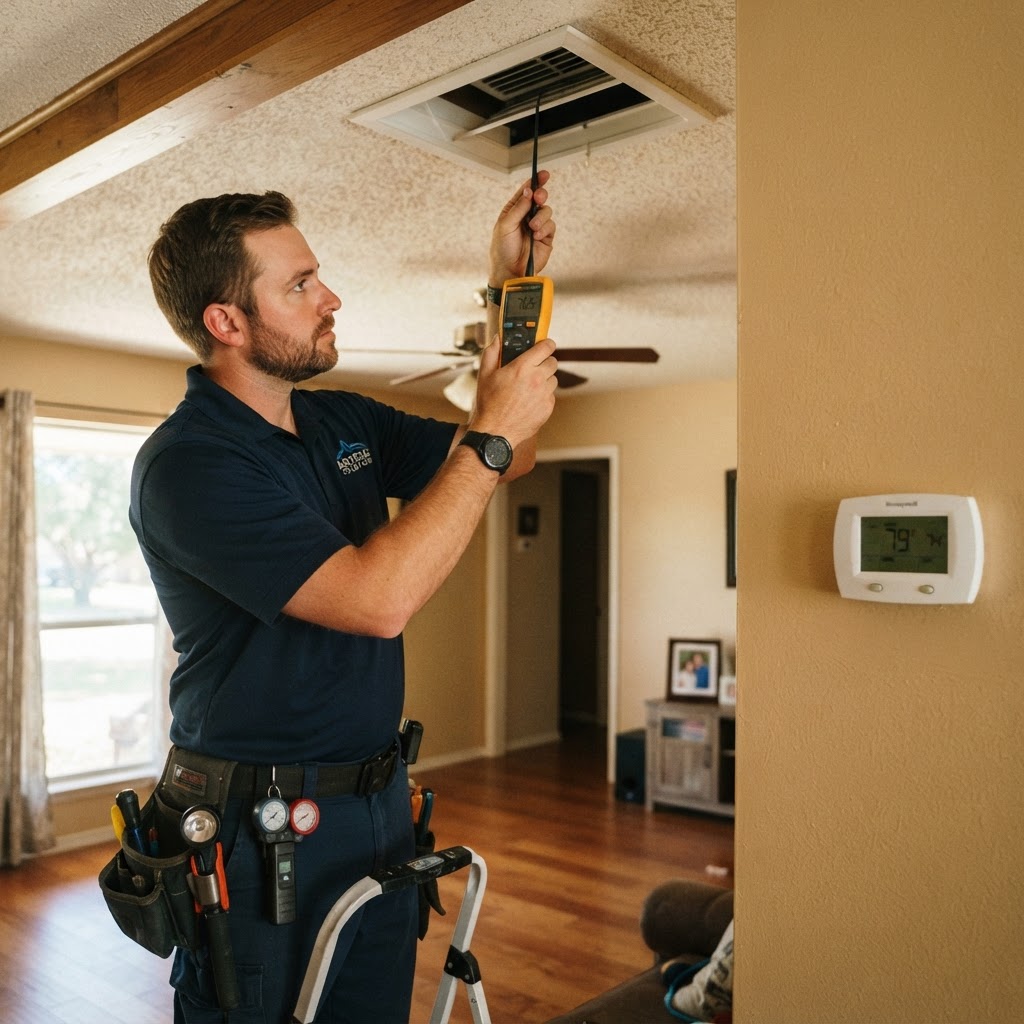
There's nothing more frustrating on a 100°F North Texas afternoon than an air conditioner that's running but blowing warm air. Before you panic, there are a handful of common — and often simple — reasons your AC isn't cooling. This guide walks North Texas homeowners through the most common causes of an AC not cooling, what you can check yourself, and when to call a professional.
First: Check the Thermostat
It sounds obvious, but a surprising number of "AC not cooling" calls start at the thermostat. Before anything else:
- Confirm it's set to COOL, not HEAT or AUTO with heating priority
- Verify the setpoint is at least 3°F below the current room temperature
- Replace the batteries if it's blank or unresponsive
- Make sure it's not in "hold" or "away" mode
If a smart thermostat recently lost Wi-Fi, it may have reverted to a default schedule. Check the app. If the thermostat screen is blank even with fresh batteries, the thermostat may have failed — a quick, affordable repair. See our thermostat guide.
AC Not Cooling: The Most Common Causes
1. Dirty or Clogged Air Filter
The #1 DIY-fixable cause. A clogged filter chokes airflow, causing the evaporator coil to freeze and the AC to blow warm or weak air. In North Texas's dusty environment, filters clog fast.
What to check: Pull the filter and hold it up to a light. If you can't see light through it, replace it. Then turn the AC off for 1–2 hours to let a frozen coil thaw, and turn it back on. If cooling returns, a dirty filter was the culprit. See our filter guide.
2. Frozen Evaporator Coil
A dirty filter, low refrigerant, or restricted airflow can freeze the indoor coil solid. Signs: weak airflow, warm humid air, ice on the copper lines, and water pooling near the indoor unit.
What to do: Shut the AC off immediately — running a frozen coil can destroy the compressor. Replace the filter and let it thaw. If it freezes again after restarting, you likely have a refrigerant leak or airflow problem and need a pro.
3. Low Refrigerant (Refrigerant Leak)
Refrigerant doesn't get "used up" — a low charge means there's a leak. Signs include declining cooling, ice on lines, hissing sounds, and longer run times. On older systems (especially R-22), a leak often tips the decision toward replacement.
What to check: You can't fix this yourself — refrigerant handling requires EPA certification. But you can confirm the symptom: ice on the suction line (the larger copper pipe) is a strong indicator. Call for service.
4. Outdoor Condenser Is Dirty or Blocked
The outdoor unit rejects heat from your home. If the coil is fouled with North Texas dust, pollen, or debris — or if bushes, fences, or patio furniture crowd it — it can't reject heat and cooling suffers.
What to check: Shut off power to the outdoor unit, hose the fins gently from the inside out, and clear 2 feet of clearance around it. If it's badly fouled, a professional chemical cleaning restores full capacity. Read our maintenance guide.
5. Tripped or Failed Capacitor
The capacitor starts the compressor and fan. If it fails, the outdoor unit may hum but not start, or start and quickly stop. You'll hear a click and hum with no fan movement.
What to check: Look at the outdoor unit — if the fan isn't spinning but the unit hums, the capacitor is the likely culprit. This is a fast, affordable professional repair — don't try to replace it yourself (capacitors hold a dangerous charge).
6. Tripped Circuit Breaker
A tripped breaker kills power to the AC. If the outdoor unit is completely dead, check your electrical panel.
What to check: Find the AC breaker, flip it fully off, then back on. If it trips again immediately or repeatedly, you have a bigger electrical problem — call a pro. Repeatedly resetting a tripping breaker is dangerous.
7. Clogged Condensate Drain
North Texas humidity produces gallons of condensate daily. If the drain clogs, a safety float switch shuts the system down to prevent water damage. The AC simply won't run.
What to check: If the indoor unit clicks but won't start and you see water near it, a clogged drain tripped the safety switch. A wet/dry shop vac on the drain line outside often clears it. If not, a pro can clean it fully.
8. Failed Contactor or Compressor
The contactor is the electrical switch that engages the compressor. If it pits and burns (common with age), the compressor won't run. If the compressor itself has failed, you'll hear humming and possibly a tripped breaker — and you're looking at a major repair or replacement.
What to check: These require professional diagnosis. If the outdoor unit hums but won't start and the capacitor looks fine, the contactor or compressor is suspect. See our signs your AC needs repair guide.
9. Leaky or Crushed Ductwork
If some rooms cool fine and others don't, or the whole house underperforms, hidden duct leaks could be wasting 20–30% of your conditioned air.
What to check: Compare supply airflow between rooms. Drastically uneven airflow suggests duct issues. A professional duct inspection finds and fixes leaks.
Quick Troubleshooting Checklist
Before you call, run through this 5-minute checklist:
- Thermostat set to COOL, setpoint 3°F+ below room temp, batteries good
- Air filter clean — replace if dirty
- No ice on the copper lines (if ice: turn off and thaw)
- Outdoor unit has power (breaker on, no tripped breakers)
- Outdoor condenser fins clear and 2 feet of clearance
- No water pooling near the indoor unit
If all of those check out and the AC still isn't cooling, it's time to call a professional.
When to Call a Pro
Call AIRmazing at (214) 555-5555 if:
- The AC runs but blows warm air after the checklist above
- You see ice on the copper lines (after thawing and a fresh filter)
- The outdoor unit hums but won't start
- A breaker trips repeatedly
- Some rooms cool and others don't (duct issue)
- The system is 10+ years old and struggling — you may be near replacement
Serving North Texas Homeowners
AIRmazing serves homeowners across North Texas — including Dallas, Frisco, Plano, McKinney, Denton, and the entire DFW metroplex.
Book AC Repair Today
Don't sweat through a North Texas heat wave with a struggling AC. Book same-day service or call (214) 555-5555 — our NATE-certified technicians will diagnose, quote upfront, and get your home cool again fast.


