
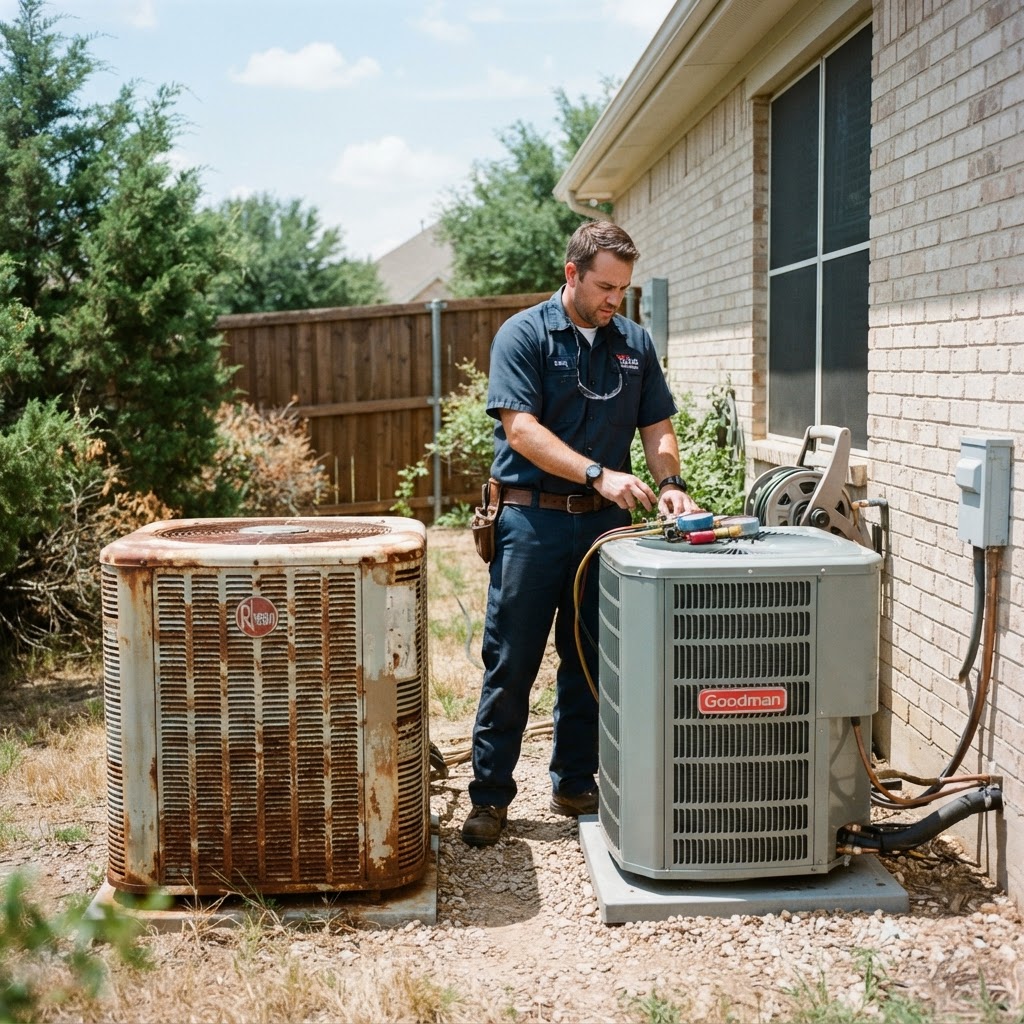
If you own a home in North Texas, one question always looms: how long will my air conditioner last? The answer matters — a new central AC is a $6,000–$12,000 investment, and a failure during a 105°F heat wave is an emergency nobody wants. Understanding how long AC units last in North Texas helps you plan, budget, and avoid a midsummer breakdown that leaves your family sweltering.
At AIRmazing HVAC Services, we've inspected thousands of systems across the DFW metroplex. Here's the honest, no-hype answer on air conditioner lifespan in North Texas, what shortens it, and the signs your unit is nearing the end.
The Short Answer: AC Lifespan in North Texas
The average central air conditioner lasts 10 to 15 years in North Texas. In milder climates, the same equipment might reach 18–20 years, but DFW's sustained summer heat cuts that short.
Here's the breakdown by component, since your AC isn't one single thing:
| Component | Typical Lifespan in North Texas | |-----------|--------------------------------| | Compressor | 10–15 years | | Condenser (outdoor unit) | 10–15 years | | Evaporator coil (indoor) | 10–15 years | | Capacitor | 5–10 years (replaceable) | | Contactor | 5–10 years (replaceable) | | Fan motor | 8–12 years | | Thermostat | 10–15 years | | Ductwork | 15–30 years (with maintenance) |
When we say "your AC lasts 10–15 years," we mean the major sealed components — compressor and coils. The smaller electrical and mechanical parts (capacitors, contactors, motors) are designed to be replaced along the way, and replacing them doesn't mean your system is dying.
Why North Texas Heat Shortens AC Lifespan
DFW's climate is uniquely punishing on HVAC equipment:
- Sustained run time — from late May through September, daytime highs exceed 95°F and often top 100°F, and nighttime temperatures rarely drop below 75°F. Your AC runs nearly continuously for months.
- Humidity load — North Texas humidity forces the AC to remove moisture on top of heat, increasing total run hours.
- Thermal stress — sustained high temperatures stress the compressor, the most expensive component, accelerating wear.
- Electrical stress — constant cycling degrades capacitors and contactors faster than in milder climates.
- Dust and pollen — heavy North Texas pollen and dust foul condenser coils, reducing efficiency and increasing compressor load.
A system that might run 1,500 hours per year in a mild climate runs 3,000+ hours per year in North Texas. More run hours = more wear = shorter lifespan. It's that simple.
What Shortens AC Lifespan in North Texas
Several factors push your AC toward the lower end of that 10–15 year range — or shorter:
Lack of Maintenance
This is the #1 lifespan killer. A system without annual tune-ups runs hotter, longer, and dirtier. A clogged filter, fouled coil, or low refrigerant charge all force the compressor to work harder. Skipping maintenance can cut a 15-year system down to 10. Read our maintenance guide.
Infrequent Filter Changes
A clogged air filter restricts airflow, causing the evaporator coil to freeze, the compressor to strain, and efficiency to plummet. In North Texas's dusty environment, filters need replacing every 30–60 days during summer. See our filter guide.
Oversized or Undersized Equipment
An oversized AC short-cycles — turning on and off every few minutes — which is harder on the compressor than running steadily. An undersized AC runs constantly without ever catching up. Proper sizing, verified by a Manual J calculation, extends lifespan. Read about signs your AC needs repair.
Poor Installation
Refrigerant undercharge or overcharge, improper airflow, and leaky ductwork all stress components. A poorly installed system can fail years before its time. This is why commissioning diagnostics matter on newer systems.
Neglected Ductwork
Leaky or crushed ducts force the system to run longer to satisfy the thermostat, adding run hours. A duct inspection every 3–5 years prevents hidden losses.
Signs Your AC Is Nearing the End
Watch for these indicators that your North Texas AC is approaching replacement:
- Age 12+ years with increasing repair frequency
- Rising energy bills despite no usage change — efficiency declining with age
- Repairs exceeding $500 more than once per season
- Uneven cooling — some rooms never get comfortable
- Refrigerant leaks recurring — especially on R-22 systems
- Loud operation — rattling, grinding, or squealing that didn't used to be there
- The system runs constantly on hot days without reaching setpoint
- Use the $5,000 rule — multiply your system's age by the repair cost. If it exceeds $5,000, replacement is usually more economical.
For the full decision framework, see our when to replace your AC guide.
How to Maximize Your AC's Lifespan in North Texas
You can't change the climate, but you can stack the odds in your favor:
- Schedule annual professional maintenance — a spring cooling tune-up keeps the system clean, charged, and catches weak parts early.
- Replace the air filter every 30–60 days during summer.
- Keep the outdoor condenser clear — 2 feet of clearance, hose the fins monthly.
- Set the thermostat to 78°F when home — every degree below 78°F adds run hours. A smart thermostat automates setbacks.
- Seal and insulate ductwork — every 3–5 years, have ducts inspected.
- Don't ignore small problems — a $180 capacitor repair ignored becomes a $3,500 compressor replacement.
When Replacement Makes Sense
If your North Texas AC is over 12 years old and facing a major repair, replacement usually wins. Modern high-efficiency systems (16 SEER2 and up) cut cooling costs by 20–40% versus a 10-year-old unit — and the savings help pay for the upgrade. AIRmazing offers financing options that make a new system affordable, often with payments lower than the energy savings.
Serving North Texas Homeowners
AIRmazing proudly serves homeowners across North Texas — including Dallas, Frisco, Plano, McKinney, Denton, and the entire DFW metroplex.
Need Help Assessing Your AC?
If your system is getting up there in years, the best move is a professional assessment — not a sales pitch. Book a diagnostic or call (214) 555-5555. Our NATE-certified technicians will give you an honest read on your system's remaining life and your options, with upfront pricing and no pressure.


