
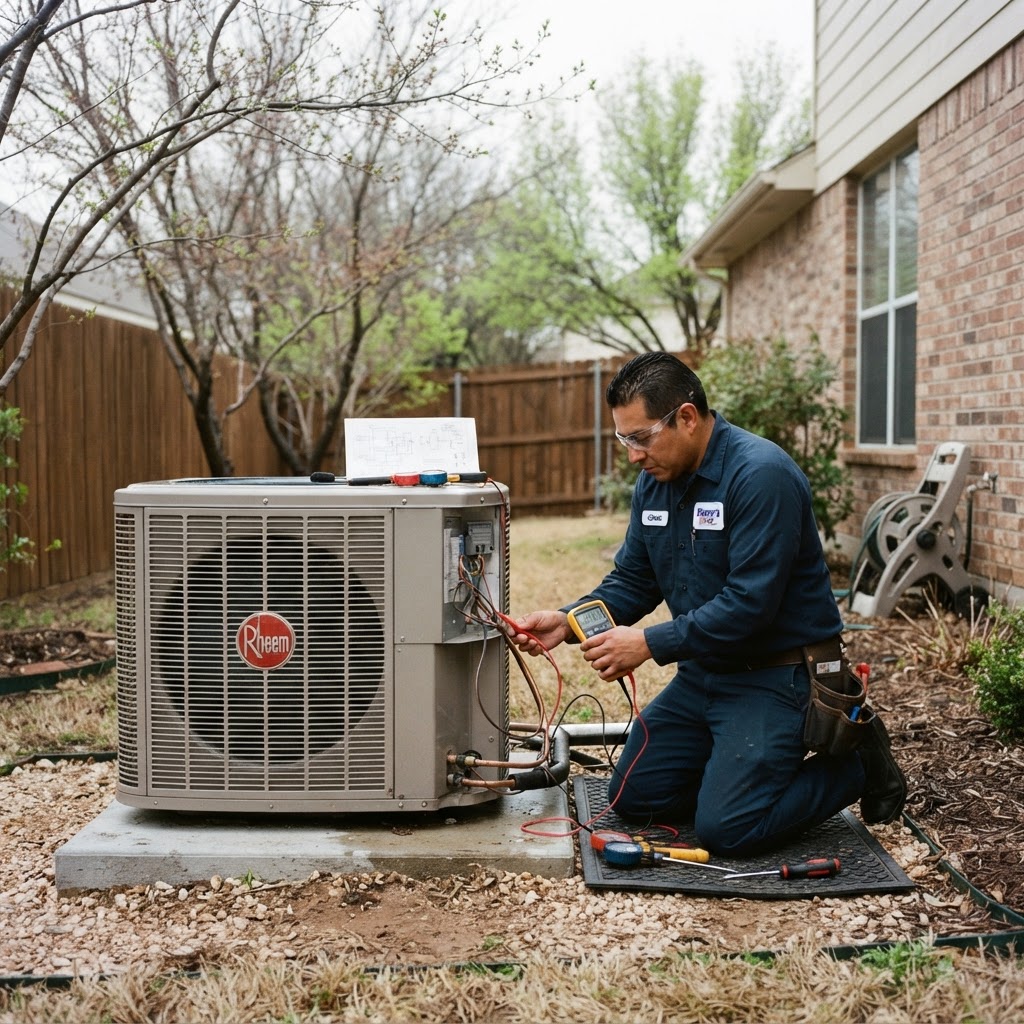
When it's time to replace your North Texas home's HVAC system, you face a key decision: a traditional air conditioner plus furnace combination, or a heat pump that handles both heating and cooling. In North Texas's climate — hot summers and relatively mild winters — the right choice is different than in colder northern states. This guide compares heat pumps vs AC and furnace systems for North Texas so you can choose with confidence.
How Each System Works
Air Conditioner + Furnace
A traditional split system pairs an outdoor AC condenser and indoor evaporator coil for cooling with a separate indoor furnace (gas or electric) for heating. The AC and furnace share the indoor blower and ductwork but are distinct appliances. In summer the AC runs; in winter the furnace runs. They never work together.
Heat Pump
A heat pump is essentially an air conditioner that can reverse direction. In summer, it moves heat from inside your home to outside (cooling). In winter, it moves heat from outside air into your home (heating) — even when it's cold outside, there's heat energy in the air that a heat pump can extract. A heat pump replaces both the AC and furnace with a single efficient system, typically with electric resistance backup (aux heat) for the coldest days.
The Climate Factor: Why North Texas Favors Heat Pumps
Heat pumps excel in mild winter climates — exactly like North Texas. Here's why:
- Mild winters: North Texas winters rarely drop below 20°F, and most winter days are 40–60°F. Heat pumps heat efficiently down to about 30–40°F, and modern cold-climate heat pumps work well below that. North Texas's coldest days fall within a heat pump's efficient range far more often than northern climates.
- Few aux-heat hours: In cold climates, heat pumps fall back to expensive electric resistance backup often. In North Texas, aux heat runs only a handful of days per year — keeping heating costs low.
- Cooling-dominated load: North Texas is overwhelmingly a cooling climate. Heat pumps cool just as well as traditional ACs, so you lose nothing in summer and gain efficient heating in winter.
Cost Comparison
Upfront Cost
| System | Typical Installed Cost in North Texas | |--------|--------------------------------------| | AC + gas furnace (standard) | $6,500–$10,500 | | Heat pump (standard) | $6,000–$9,500 | | High-efficiency heat pump (variable-speed) | $9,000–$13,000 | | Dual-fuel (heat pump + gas furnace backup) | $10,000–$15,000 |
A heat pump is often comparable to or slightly less than an AC + furnace combo upfront — you're buying one appliance instead of two. Installation complexity and ductwork condition affect the final number.
Operating Cost
This is where heat pumps often win in North Texas:
- Cooling: Heat pumps and ACs cost the same to cool.
- Heating: A modern heat pump is 200–300% efficient (it moves heat rather than generating it), compared to a 95–98% efficient gas furnace. Even with electricity typically costing more per BTU than natural gas in North Texas, the heat pump's higher efficiency often makes heating costs comparable — and sometimes lower.
- Aux heat: The main risk is electric resistance backup on the coldest days, which is expensive. In North Texas, those days are few.
Your actual operating cost depends on your local electricity vs gas rates. AIRmazing can run the numbers for your specific utility rates and home.
Efficiency Comparison
- Cooling efficiency (SEER2): Heat pumps and ACs use the same scale and achieve similar ratings.
- Heating efficiency (HSPF2): Heat pumps are rated by HSPF2. Modern heat pumps achieve 8–10 HSPF2, meaning 250–300%+ efficient heating. A gas furnace maxes out around 98% AFUE.
- The COP advantage: A heat pump's coefficient of performance (COP) of 2.5–3.0 means it produces 2.5–3 units of heat for every 1 unit of electricity consumed — far more efficient than any furnace.
Comfort Comparison
Heat Pump Comfort
- Even, steady heat: Heat pumps deliver lower-temperature, continuous heat — fewer temperature swings than a furnace's on/off blasts.
- Quieter operation: Modern variable-speed heat pumps run quietly.
- No combustion: No gas furnace means no combustion byproducts, no chimney, and no carbon monoxide risk — a safety advantage.
- Dehumidification in cooling: Identical to a traditional AC.
Furnace Comfort
- Fast recovery: A gas furnace heats a cold home quickly — useful after a deep setback.
- Hot supply air: Furnace supply air (~120–140°F) feels warmer at the register than heat pump supply air (~95–110°F).
For most North Texas homeowners, heat pump comfort is excellent — the climate simply doesn't demand furnace-style rapid recovery.
Lifespan and Maintenance
| Factor | AC + Furnace | Heat Pump | |--------|--------------|-----------| | Cooling component lifespan | 10–15 years | 10–15 years | | Heating component lifespan | 15–20 years (furnace) | 10–15 years (heat pump runs both seasons) | | Year-round use | No (seasonal) | Yes (heats and cools) | | Maintenance | Two systems to maintain | One system to maintain |
A heat pump runs year-round, so it accumulates hours faster than a seasonal AC or furnace — but modern heat pumps are built for it, and you maintain only one system instead of two.
Environmental Considerations
Heat pumps are significantly greener:
- No on-site combustion (no gas burned in your home)
- Powered by an increasingly clean electric grid
- 2–3x more efficient heating than any furnace
- Eligible for federal and utility efficiency rebates and tax credits
Many North Texas homeowners choose heat pumps specifically for the environmental and electrification benefits.
Which Is Best for North Texas?
For most North Texas homeowners replacing a full system, a heat pump is the better choice because:
- The mild winter climate keeps heat pumps in their efficient range
- Cooling performance equals a traditional AC
- Upfront cost is comparable (one appliance vs two)
- Operating costs are competitive, often lower
- Simpler — one system to maintain
- Safer — no combustion, no carbon monoxide
- Greener — higher efficiency, no on-site fossil fuels
A dual-fuel system (heat pump + gas furnace backup) is worth considering if you already have gas service and want the absolute lowest heating cost on the coldest North Texas days — the heat pump handles most of the winter, and the furnace kicks in only during rare cold snaps.
An AC + furnace still makes sense if: you have an existing functioning furnace and only need to replace the AC, your gas rates are unusually low, or you strongly prefer the fast recovery and hot supply air of a gas furnace.
Serving North Texas Homeowners
AIRmazing installs and services both heat pumps and traditional AC + furnace systems across North Texas — including Dallas, Frisco, Plano, McKinney, Denton, and the entire DFW metroplex.
Want Help Choosing the Right System?
The best system depends on your home, utility rates, existing equipment, and preferences. Book a free consultation or call (214) 555-5555 — our NATE-certified technicians will evaluate your home, run the efficiency and cost numbers for your specific situation, and recommend the right system with no pressure.


