
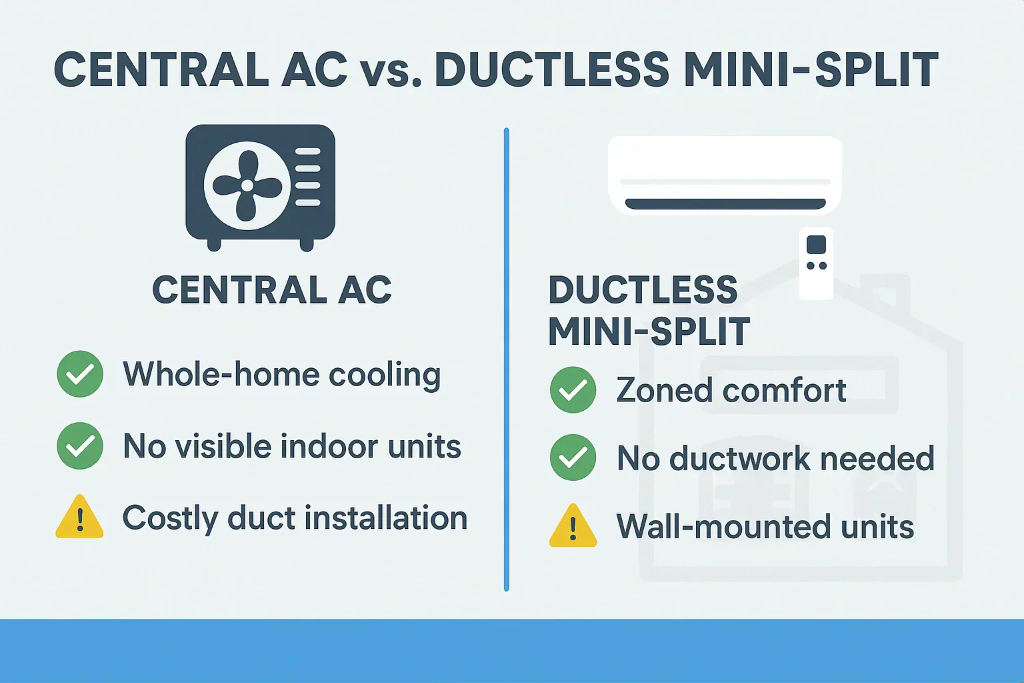
For decades, the decision was simple: want air conditioning? Install a central system with ducts. But ductless mini-splits have changed the playing field, offering efficient zone-by-zone cooling (and heating) without ductwork.
So which is better — ductless mini-split vs. central AC? The honest answer: it depends on your home. Each has a clear best-use case. In this guide, we compare them across every dimension that matters: cost, efficiency, installation, comfort, noise, aesthetics, and lifespan.
How Each System Works
Central air conditioning uses an outdoor condenser connected to an indoor evaporator coil mounted on your furnace or air handler. A single blower pushes cooled air through a shared network of ducts to every room. One system controls the whole home's temperature from a single thermostat (or multiple zones with dampers).
Ductless mini-splits pair one outdoor condenser with one or more indoor wall- or ceiling-mounted units, each connected by a small refrigerant line. Every indoor unit has its own blower, its own controls, and its own temperature — meaning independent heating and cooling per room, with no shared ductwork.
Cost Comparison: Mini-Split vs. Central AC
| System | Single Zone | Multi-Zone (Whole Home) | 3-Ton Central | |--------|------------|------------------------|---------------| | Equipment | $900–$2,500 | $4,000–$9,000 | $1,800–$3,000 | | Installation | $1,500–$4,000 | $5,000–$10,000+ | $3,000–$6,000 | | Total Installed | $2,800–$6,500 | $9,000–$19,000+ | $5,000–$9,000+ |
For a full line-by-line breakdown of what goes into pricing, read our guide on AC installation cost.
Efficiency: Mini-Split vs. Central AC
Ductless mini-splits have a built-in efficiency advantage: no duct losses. As much as 30% of a central system's conditioned air can leak through poorly sealed ducts in unconditioned attics or crawl spaces. Ductless systems sidestep this entirely.
Modern mini-splits reach SEER ratings of 20–38, compared to central systems at 14–22 SEER. Inverter-driven compressors (standard on mini-splits, available but premium on central) adjust speed to match cooling demand precisely rather than cycling on and off — saving energy and delivering steadier temperatures.
Installation Differences
Central AC installation requires existing ductwork. If your home has ducts from a prior system or a gas furnace, a new central unit hooks in cleanly — usually a same-day job. No ducts? Add $2,000–$6,000 for new ductwork, plus the disruption of cutting into walls and ceilings.
Mini-split installation requires a 3-inch hole in the exterior wall for each indoor unit's refrigerant line, drain, and electrical cable. That's much less invasive than ductwork — but every indoor unit needs a wall mount (for wall units) or ceiling clearance (for cassettes).
For a 1–2 room setup, mini-splits are far less disruptive. For a whole-home swap with existing ducts, central AC is faster to install.
Zoning and Comfort
Central AC can technically zone with motorized dampers in the ducts, but the zones are coarse and zone control adds expense. A single-thermostat central system can leave back bedrooms warm while the main living space is comfortable.
Mini-splits achieve true zoning — each room has its own thermostat, its own temperature, and its own system. This is ideal for households where different family members prefer different temperatures.
Where central AC pulls ahead: temperature consistency and humidity removal. A properly sized central system dehumidifies better because the air moves across a large cold coil. Mini-splits, while energy-efficient, can struggle to remove enough humidity, especially on mild but muggy days.
Lifespan and Maintenance
| | Mini-Split | Central AC | |--|------------|------------| | Lifespan | 12–15 years | 15–20 years | | Maintenance | Clean each head's filters + coil every 6 months | Annual coil cleaning, filter every 3 months | | Failure modes | Refrigerant leaks at heads, condensate drain clogs | Compressor, capacitor, fan motor | | Repair cost | $400–$900 per head | $300–$600 most common |
Which System Should You Choose?
Central AC wins when:
- Your home already has ductwork in good condition
- You're cooling 3+ bedrooms plus common areas
- You value uniformity and quiet, hidden distribution
- Budget is the primary concern for whole-home cooling
Mini-splits win when:
- You have no existing ductwork
- You're cooling a new addition, garage conversion, or sunroom
- Individual room temperature control matters
- You want a single system for both heating and cooling
The Verdict
There is no universal better system. Central AC is best for whole-home cooling in homes with ducts. Mini-splits are best for targeted room-by-room cooling and homes without ductwork.
If you're in DFW and weighing which direction to go, book an estimate. We'll evaluate your home, account for your existing infrastructure, and recommend the system that actually fits — with no pressure and straight dollar numbers on both options.


